Showing posts with label Topps 1972 baseball cards. Show all posts

Thursday, August 6, 2015

In Action Cards

The Topps 1972 baseball set included a set of In Action cards.  Prior to the beginning of the 70s, Topps had issued very few game action pictures in their cards sets.  Looking at sets issued by Topps now, the in game action photography is superior when compared with the sets from yesteryear.
 
In 1972, when Topps issued the In Action cards, the photographs that were used would likely not make the cut and would probably not be included in current day sets. 
 
The 1972 Topps Set

Here are a few of the In Action cards from the 1972 set.
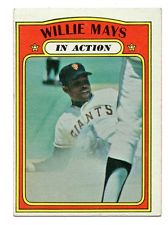
1972 Topps Willie Mays Card #50
 
1972 Topps Johnny Bench Card #434
 
1972 Topps Juan Marichal Card #568 
 
These are some nice photographs, maybe like pictures you could take today with your cell phone while sitting in the stands if your seat was close to the field.  Each of these pictures appear to have been taken at Candlestick Park.  Note the astro turf in the shot behind Willie Mays is similar to the turf that was in Candlestick Park during the 1970s.  The Johnny Bench picture has him eying a foul ball with a Giant player in the background.  The Juan Marichal shot is also from Candlestick Park as the fence and seats pictured in left/centerfield are from there. 
 
Earlier Topps Sets
 
Photos used in the earlier Topps sets were mainly portrait head shots or posed batting, fielding, or throwing shots.  The current Heritage product does bring back memories of collecting the cards from those earlier Topps sets
 
Some examples of head shots:
1966 Topps Don Mossi Card #74
 
In the baseball book Ball Four, when Jim Bouton describes Mossi’s protruding ears, he says Mossi “looked like a cab going down the street with its doors open.”
 
1962 Topps Roger Craig Card #183
 
Posed batting stances:
 

1961 Topps Yogi Berra Card #425

1965 Topps Frank Robinson Card #120
 
 
Some posed fielding shots:
1957 Topps Roy Smalley Card #397
 
1966 Topps Clete Boyer Card #9
 
Posed throwing shots:
 
1968 Topps Rod Carew Card #80
 
1969 Topps Nolan Ryan Card #533
 
Hey Nolan, nice toss but isn't that a ball that still in your glove.
  
And as San Francisco Giant announcer Mike Krukow may say, here are cards of catchers "in the squaaat".  In early sets, Topps used many posed shots of catchers in the squat.
 
1967 Topps Jerry Grote Card #413
 
1970 Topps Russ Gibson Card #237
 
The Topps 1956 set
 
In the Topps 1956 set, some of the cards had game action shots.  These action pictures were used in the background of the cards which also included portraits of the players. 
 
Topps 1956 Jim Piersall Card #143
 
Topps 1956 Elston Howard #208
 
Prior to the 1956 issue, no Topps card had a photo of an in action shot. 
 
Other game action shots in early Topps Sets
 
After the 1956 set, Topps used limited game action shots.  In the 1959 set, Topps issued a set of "Baseball Thrills" cards.  These cards showed game action photos of the stars of the day including, Mickey Mantle, Duke Snider, Willie Mays, Hank Aaron, Ernie Banks, and Al Kaline.
  
1959 Topps Hustler Banks Wins M.V.P. Award Card #469
 
World Series Cards
 
Beginning in 1960, Topps begin issuing World Series cards commemorating the World Series games from the previous year.  In the 1960 set, Topps issued cards from the 1959 World Series between the Los Angeles Dodgers and Chicago White Sox.
 
1960 Topps Luis Swipes Base Card #389
 
In all sets beginning in 1960 and through the 1975 set, except for 1966, Topps issued World Series cards from each World Series game played.  These cards pictured action shots from those World Series games. 
1961 Topps Mantle Slams 2 Homers Card #307
 
1964 Topps Koufax Strikes Out 15 Card #136
 
1968 Topps Brock Socks 4-Hits in Opener Card #151
 
 Topps 1961 and 1962 Sets
 
The Topps 1961 set issued a subset of cards that celebrated some of the greatest feats in baseball history.  Some of these cards used game action photographs.  The cards commemorated Don Larsen perfect game in the 1956 World Series, Roger Hornsby batting .424 in 1924, and the May 1, 1920 game between Brooklyn and Boston which went 26 inning and ended in a 1 - 1 tie.  During that game, each team's starting pitcher, Leon Cadore, for the Brooklyn Robins,  and Joe Oeschger of the Boston Braves, who graduated from Ferndale (California) High School, pitched all 26 innings in what is the longest game in major-league history.
 
One of the cards in this subset was Babe Ruth hitting his 60th home run.  Who would have thought that the 1961 season would be the year that Ruth's record would be broken, as Roger Maris hit 61 home runs during this season.
1961 Topps Babe Ruth Hits 60th Homer Card #401
 
In the Topps 1962 set, cards were issued of action shots of players from the 1961 season.  The cards showed a series of photographs of these players.  Cards for Whitey Ford, Warren Spahn, Harmon Killebrew, and Stan Musial were included in the set.  Also there was a card showing Roger Maris hitting his 61st home run of that season.
         
1962 Topps Maris Blast 61st Card #313
 
Topps 1971 set 
 
With the 1971 set, Topps reintroduced use of action photos for player regular issue cards for the first time since the 1956 set.   These shots would be primitive compared to standard used for cards for today.

One of the classic from the set is the Thurman Munson card.  Here he is making a play at the plate in a game against the A's.

1971 Topps Thurman Munson Card #5
 
Another classic that I like is the Nolan Ryan card.  
 
1971 Topps Nolan Ryan Card #513
 
It appears that many of the game action shots in the 1971 set were taken in New York, at either Yankees Stadium or Shea Stadium.  The Nolan Ryan shot could have quite possibly been taken on May 30, 1970, when the Astros were visiting the Mets.  The Mets won the game 4 - 3.  Ryan started that game and pitched eight inning and was winning pitcher.

The Bud Harrelson card from the set shows him making a tag at second base.  This play could be from the 8th inning of that May 30 game, when Astro Jimmy Wynn stole second base.  Note that Nolan Ryan is in the foreground of this picture facing second base.  Wynn was safe on this play.

1971 Topps Bud Harrelson Card #355
 
 
The Thurman Munson shot could have been from games that the Yankees played against the A's in May of 1970.
 
Note the Joe Rudi card from the set.  Here Rudi is playing first base as a Yankee player is leading off the bag.  On July 16, 1970, the A's were visiting Yankees Stadium, to play the Yankees.  During the first game of a doubleheader on that day, Rudi was in the lineup playing first base.  The Yankees and A's played a four game series that July.  Rudi only appearance at first base during that series was in the first game of July 16 doubleheader.
 
1971 Topps Joe Rudi Card #407
 
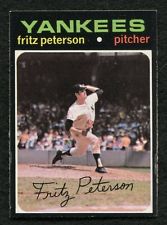
The Yankees starting pitcher from that game was Fritz Peterson and the picture for his card from the 1970 set could have possibly been taken during that same game.
 
1971 Topps Fritz Peterson Card #460


As time went by, Topps started in included cards with more game action shots.  By the early 1980s, when Donruss and Fleer begun issuing cards, needing to keep up with the market's new competition, Topps include many more cards with game action shots.  In 1989, Upper Deck entered the baseball card market. So by the earlier 90s, all card makers started to issue more game action shots using outstanding photography.   The pictures on cards almost became works of art.  That still continues today, has Topps uses great photographs with their current baseball card products.
2015 Topps Cole Hamels Card #10

2015 Stadium Club Rougned Odor Card #126

Topps Stadium Club has provided some of the finest work with game action shots.  A couple of my favorite Stadium Club cards are from their 1999 set.

1999 Stadium Club Greg Maddux Card #100

1999 Stadium Club Jim Thome Card #120
 
 
These scans are not that great but check out Braves pitcher Greg Maddux sliding into second base breaking up a double play.  The Jim Thome card is cool because the picture is taken as he is just getting ready to make a catch a foul ball and the shadow of the ball is next to his right knee.
 
Probably one of my favorite cards is Shane Mack from the Topps 1991 set.  Mack appears all by himself as he is hanging on to third base, leaving a trail from his slide, as his helmet is bouncing away. 
1991 Topps Shane Mack Card #672
 
Can you share some of your favorite cards.     

Sunday, July 5, 2015

Good-Bye, Candlestick Park

The reports from the Bay Area this week say that work crews have completed the demolition of Candlestick Park.  The former home of the Giants and 49ers has now been leveled to the ground.  Planning now for the site is for the construction of an outlet mall, a hotel, and 600 homes to be built by late 2017 or early 2018.

Candlestick Park opened on April 12, 1960 as Vice-President Richard Nixon threw out the opening pitch for the baseball game between the Giants and Cardinals.  The Giants won the game 3 to 1, as starting pitcher Sam Jones pitched a complete game three-hitter.  The game's first runs scored came on Orlando Cepeda's 1st inning triple which plated Don Blasingame and Willie Mays.

2010 Topps Heritage Flashback Card #BF6

Candlestick Park served as the home of the San Francisco Giants from 1960 through 1999 and home for the San Francisco 49ers from 1971 through 2013. 

A history of events at Candlestick Park include:

The 1961 All-Star Game
 

The 1961 All-Star Game was played at Candlestick Park.  A gust of wind reportedly caused relief pitcher Stu Miller, then a member of the Giants, to be blown off the mound.  In the top of the 9th inning when Miller, who replaced Sandy Koufax, went into the stretch for his first pitch, a fierce gust of wind hit his shoulder. As Miller remembers, the result was more like a flinch than being blown off the mound.  The play resulted in a balk. Later in the inning, the American League tied the game 3 - 3 when Al Kaline scored on Ken Boyer's error on Rocky Colavito's grounder.  Miller gave up an unearned run in the top of the 10th inning as the American League took a 4 - 3 lead.  However, Miller's National League teammates bailed him out in the bottom of the 10th inning and made him the winning pitcher.  Against Oriole and American League reliever, Hoyt Wilhelm, Hank Aaron lead off the inning with a single and he scored on a double by Miller's Giant teammate Willie Mays to tie the score.   After Wilhelm hit Frank Robinson with a pitch, Mays scored the winning run on Roberto Clemente's single.

Roberto Clemente, Willie Mays, and Hank Aaron stand together for a picture after the 1961 All-Star Game 
 
Game Seven of the 1962 World Series
 
The 1962 World Series matched the New York Yankees and the San Francisco Giants.  With the Series tied 3 games a piece and the Yankees leading the Giants 1-0 going into the bottom of the ninth of game seven, Giants pinch-hitter Matty Alou led off with a base hit bunt. His brother Felipe struck out, as did second baseman Chuck Hiller.  Willie Mays came up and hit a line drive double into the right field corner. Alou rounded third and thought about scoring but held up, not wanting to test the arm of Yankees right fielder Roger Maris.
 
With men on second and third and Giants slugger Willie McCovey coming to the plate, the Yankees and their ace Ralph Terry had a decision to make. Should Terry pitch to McCovey, who had a triple in the game and had hit a home run off Terry in Game 2? Or should Terry walk McCovey to load the bases and take his chances with another Giants heavy hitter, Orlando Cepeda?
 
The Yankees chose to pitch to McCovey.
 
On the first pitch, McCovey hit a foul ball near the right field stands. Terry then threw a fastball inside that McCovey got around on, launching a shot right at Yankees second baseman Bobby Richardson, who snagged the line drive, ending the game and winning the World Series for the Yankees. McCovey would later say it was the hardest ball he ever hit.
 
1963 Topps 1962 World Series Game #7 Yanks Celebrate as Terry Wins Card #148

The Beatles Live at Candlestick Park

At Candlestick Park, on August 29, 1966, the Beatles had their last live concert.  What is remembered about The Beatles' farewell concert performance is that only half the tickets were sold, leaving some 25,000 seats in the stadium empty.


The 49ers arrive for the 1971 Football Season
 
Candlestick Park was enclosed during 1970–71 in preparation for the 49ers arrival, scheduled for the beginning of the 1971 football season.  Pictures for some cards from the 1972 Topps baseball set were taken at Candlestick Park during the 1971 season.  These cards show the construction of the upper deck, which added seats for football and enclosed the stadium.
 
Topps 1972 Frank Duffy Card #607
 
Frank Duffy was a member of the 1971 Giants.  In May of that year, he was traded to the Giants in a deal that sent outfielder George Foster to the Reds.  After the season ended, in November, Duffy was traded to the Indians in a deal that sent him and pitcher Gaylord Perry to Cleveland and brought pitcher Sam McDowell to San Francisco.
 
This card of Fran Duffy was selected because he was photographed as a Giant in Candlestick Park sometime during the 1971 season.  His cap was airbrushed to included the Cleveland "C".  Also, if you look over his right shoulder you will note that the bowl that was constructed to enclose Candlestick Park was not yet completed and was still being worked on.
 
This Ted Sizemore card, is a better picture of the work being done to enclose Candlestick Park.  Note, over Sizemore's right shoulder, the framing for the future upper deck of the park.
 
Topps 1972 Ted Sizemore Card #514
 
Some of the other cards from the Topps 1972 set that show the construction of the upper deck of Candlestick included: Doug Rader Card #536, Jerry McNertney Card #584, Jim Ray Card #603, Ivan Murrell Card #677, Don Mason Card #739, Jim Wynn Card #770.
 
The Catch
 
It was January 10, 1982, and the San Francisco 49ers were hosting the Dallas Cowboys for the National Football Conference (NFC) Championship.  The upstart 49ers were returning to the championship game for the first time since the Cowboys defeated them 14-3 on January 2, 1972.  The Cowboys had appeared in eight of the first eleven NFC championship games, winning five of them, as the 49ers had yet to made it to the Super Bowl.
 
The Cowboys lead the game at halftime 17 - 14, and as the third quarter ended the 49ers had gone ahead 21 - 17.   One minute into the fourth quarter, the Cowboys kicked a 22-yard field goal that cut the 49ers lead to 1 point. The Cowboys then recovered a fumble at midfield to set up a touchdown pass by their quarterback, Danny White, giving Dallas a 27–21 advantage. Things got better for Cowboys when cornerback Everson Walls recorded his second interception of 49er quarterback Joe Montana on the 49ers next drive. Dallas managed to pick up a few more first downs, but was forced to punt, and the 49ers got the ball at their own 11 with 4:54 left in the game.
 
Montana subsequently led the 49ers 83 yards to the Dallas 6-yard line.  Facing 3rd down and 3 on the Cowboys 6 with 58 seconds left, Montana rolled to his right to avoid the Cowboy rush and threw a high pass that wide receiver Dwight Clark reached in the air and caught for what ended up being the game-winning touchdown reception. 


However, the Cowboys needed only a field goal to win, and had enough time left in the game for one last drive. White threw a completion that almost went for a touchdown, as Cowboy receiver Drew Pearson was caught at midfield by defensive back Eric Wright, with a game saving tackle. One play later, the 49ers sacked White, forcing a fumble that they recovered.  The 49ers had their victory and were headed to Super Bowl XVI.  Between 1982 and 1995, the 49ers appeared in and won five Super Bowls.
 
Montana's throw to Clark will always be remember by 49er fans as simply "The Catch".
 
Game Three of the 1989 World Series

1990 Score Lights Out: Candlestick Card #701
 
The World Series was scheduled to return to Candlestick Park on October 17, 1989. The series matched the  Bay Area's two teams, the National League Champion Giants against the American League Champs, Oakland A's.  At 5:04, about twenty-five minutes before the beginning of Game 3, a 7.1 magnitude earthquake struck the San Francisco Bay Area. After the quake, police and players wandered the field in bewilderment, unaware the quake had rocked the area's bridges and highways, and that there were fires in downtown San Francisco. At approximately 5:35 p.m., after coming to the conclusion that the power at the park couldn't be restored before sunset, Commissioner Fay Vincent postponed the game, setting no date as to when the series would continue.  The earthquake killed 63 people and demolished several bridges.  Candlestick Park survived with limited damage and Game 3 begun 10 days late as the A's eventually won the World Series.
 
Paul McCartney Closes Candlestick Park
 
At the age of 72, Paul McCartney took the stage at Candlestick Park on Aug. 14, 2014.  After 54 years, this was the final show to ever be performed at Candlestick Park.  McCartney's performance was within days of being 48 years after the Beatles played their last concert at Candlestick.


My memories of Candlestick Park


My first trip to Candlestick Park was as a teenager during the first weekend of September 1977 for a Giant and Cardinal game.  I had just graduated from high school and I attended the game with a classmate.  The feeling that I remember was that as I walked from the concourse to my seat, and I saw the field for the first time, the green of the grass just splashed on me.  I don't know how to best to describe those feelings, but I'd seen a lot of major league games on a black and white TV (that was the only TV my family had), but this was the first Giants game that I was attending.  I will always remember the colors and sounds and the excitement of being in the crowd at the beginning of the game. 
 
I was able to return to Candlestick Park for about twenty Giants games.  I never had a chance to attended any 49er games.  Some of my memories of those games were that even in the middle of the summer, I always worn a down jacket to night games as the stadium was normally foggy, windy, and cold.  I also remember going to Sunday doubleheaders.  Since I lived so far from the city, on these days, I would normally stick around until the bitter end of the second game.  I just remember being so exhausted at the end of the second game, and always wondered how tired the players were.  I feel sorry now that the younger fans of today don't ever get the chance to experience a doubleheader.
 
One game I remember was the Giants home opener for the 1979 season.  The Giants were coming off a third place finish in 1978, when they had a 89 - 73 record and finished six games behind the first place Dodgers.  After completing the 1978 season with their best record since they had won the National League Western Division in 1971, there was a lot of excitement for the 1979 season.  The Giants lineup included third baseman Darrell Evans and 23 year-old right fielder, Jack Clark.  Also, Billy North was signed away from the Dodgers as a free agent and was to start in centerfield, and Bill Madlock was going to play second base.  The pitching staff was lead by All-Star left hander, Vida Blue.
 
Tickets were in high demand for the April 10 opener, as the Giants were hosting the Padres.  A buddy of mine and I ordered our tickets in December and ended up getting box seats in the upper deck above the right field foul pole.  The game was tied 2 - 2 in the bottom of the ninth as former Giant pitcher John D'Acquisto entered the game for the Padres, replacing starter, another ex-Giant hurler, Gaylord Perry.  D'Acquisto retired the Giants first two batters of the inning.  Giants Manager Joe Altobelli pinched hit for shortstop Roger Metzger, sending Willie McCovey to the plate.  McCovey singled to keep the inning alive.  Max Venable ran for McCovey and John Tarmargo was sent up to pinch hit for Vida Blue.  Tamargo homered and the crowd went wild as the Giants won the game 4 - 2.
 
This spring I was in the Bay Area and drove north up 101 by Candlestick Park.  The demolition was in progress as sections of the park had already been removed.  Looking back now, maybe I should have stopped and taken a few pictures, but as I drove with traffic, I said my good-bye to the Stick.
 
Candlestick Park 1960 - 2015
 
Photo of Candlestick Park taken 8/22/09 of preseason football game of 49ers vs Raiders

Photo taken 6/30/15 as the demolition of Candlestick Park ends